How to Qualify a Contractor Lead in Seven Minutes
A phone screening method that grades a lead from -5 to +5 in a suggested five to seven minutes, before anyone drives anywhere. Five criteria, three possible scores each, one sum that points to the next step.
Two leads, the same five questions
Before the method, the output. These are two leads scored on identical criteria, and the scores are the only thing different about them.
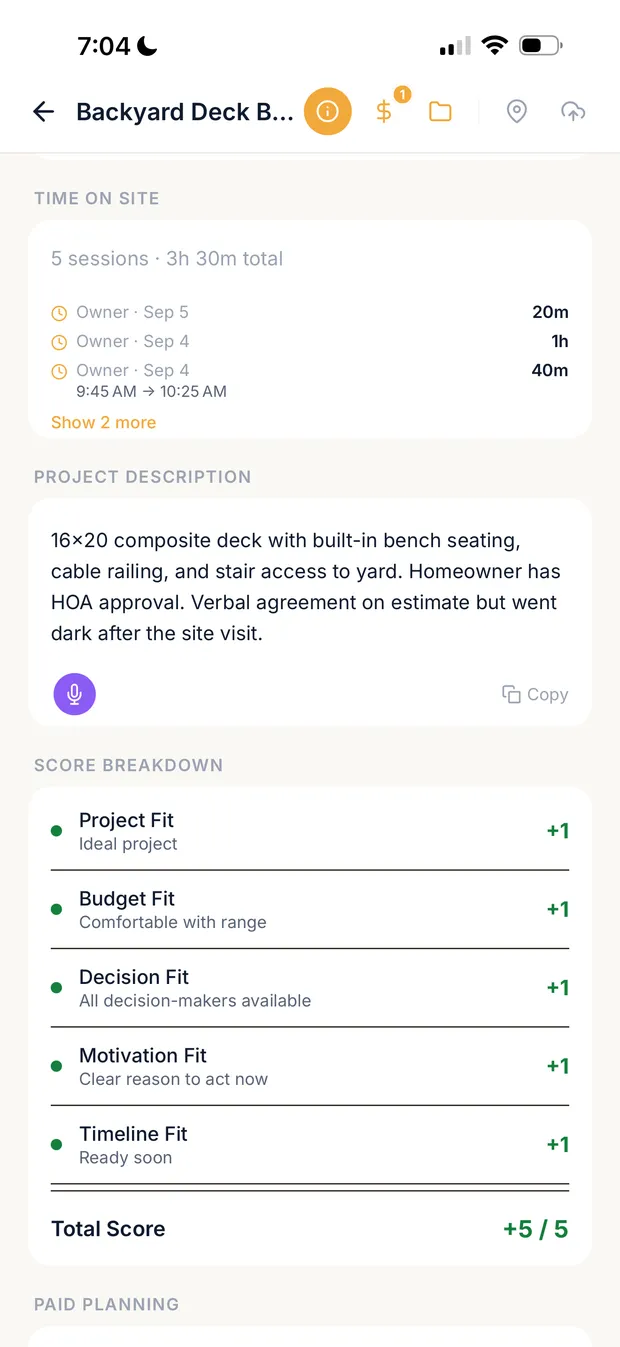
+5 - book it
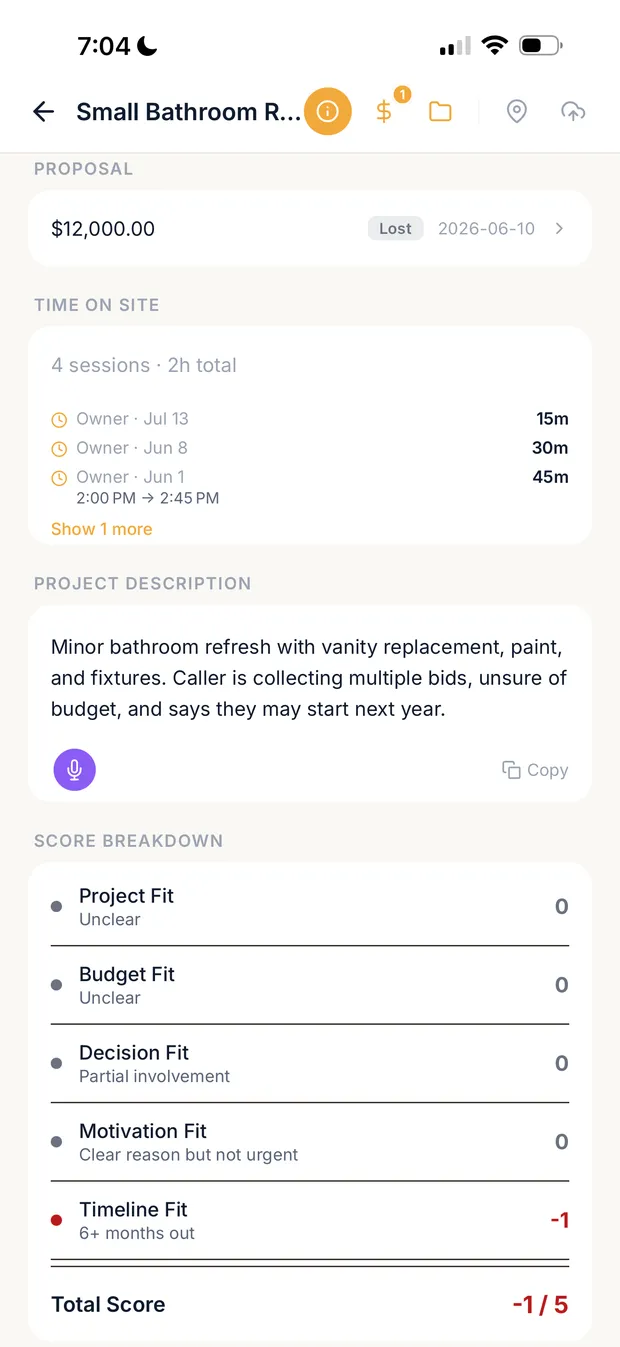
-1 - exit politely
Two illustrative leads scored on identical criteria. Demo data.
Five rows on each screen, the same five every time. One came back at the top of the scale and gets a paid planning conversation. The other came back below zero and gets a polite exit, decided on the phone before anyone drove anywhere.
The rest of this page is how you get those five answers, and what the number they add up to means.
The scale
Five of the eleven possible totals fall in Bad Fit and two in Great Fit. The bands are not evenly sized, and that asymmetry is deliberate: the method is built to sort out the calls that are not worth a visit, and it gives that outcome the most room.
Treating every inbound call as a sale to win is the habit this method is built against. It treats the call as a filter to run instead. The premise is the course author's: not every customer is your customer. A customer who will not take part in the qualification process is showing you something, and he treats that as the first strike rather than as an automatic ending.
Filtering costs five to seven minutes of phone time. That is the time budget the method suggests, not a measured average. What it is weighed against is the site visit, the free estimate, and the evening spent pricing work for someone who was not going to buy.
The opening frame
Before any scheduling talk, ask for the call itself.
Before we get started or schedule an in-person visit, I just need five to seven minutes to understand your project and make sure we're a good fit, so we don't waste anybody's time. Does that sound good?
Friction at this request is the first red flag, and it counts. Be careful what you read into it, though. Someone who cannot talk right now is not refusing your process; someone who will not agree to the conversation at any time is telling you something. Treat the second as a refusal of the process. It is a red flag toward the exit rule below, and it carries no numerical score, because this question is not one of the five.
The author asks the five in a set order, because the answers build on each other: you cannot name a price range before you know the project. Motivation and timeline can stand on their own, and either can surface a mismatch by itself, but they are asked last.
The five criteria
Does what they describe match your normal work? A normal job is a scope you have repeated enough times to estimate reliably. If you remodel bathrooms and the caller wants a deck, that is not your normal job. It is not automatically a dead lead, and it might be a green flag for another contractor, but for you it scores against.
- +1 · Ideal project the request sits squarely in work you repeat.
- 0 · Unclear adjacent to your work, or the scope is not yet defined enough to say.
- −1 · Wrong project / too small outside what your business is set up to estimate and produce.
Can you name your range for this work, and does it land inside their expectations? This assumes the pricing homework is done before the phone rings: you know your overhead, your profit target, and therefore the markup that turns a job cost into a price you can deliver at. The break-even guide works the related question of what annual revenue covers your overhead at zero profit.
Based on what you're describing, for a bathroom this size we'd be somewhere around $30,000.
- +1 · Comfortable with range your range lands inside their expectations.
- 0 · Unclear hesitation, or a number they need to think about.
- −1 · Too low / unrealistic their stated budget does not accommodate your range for the scope discussed. Worth clarifying whether the budget or the scope can move.
Will everyone involved in the decision take part? Ask directly: is anyone else involved in the decision on this project? If a spouse or partner has some opinions but will go along with whatever I say, do not argue; agree, and redirect.
What you are testing for is a commitment, not attendance in itself. A spouse who is at work right now is not an absent decision maker; a spouse who will not be part of the decision at any point is. Remote attendance or an agreed way of deciding can both count.
Totally get it. We've found projects work best when everyone involved in the final decision is available for our meeting. If that doesn't work now, we can reschedule.
- +1 · All decision-makers available everyone needed is identified and can take part through whatever process you agree on.
- 0 · Partial involvement required participation or authority is unconfirmed.
- −1 · Missing decision-maker a required decision maker cannot be reached through any agreed process.
Will finishing this project meaningfully change something? An upcoming family event, embarrassment about the state of a kitchen, twenty years of putting it off finally compressed into now. Those are the +1 answers.
- +1 · Clear reason to act now something concrete makes this the moment.
- 0 · Clear reason but not urgent a real reason, no pressure behind it.
- −1 · Just exploring / shopping curiosity only.
Establish their acceptable start window, the date they need it finished, and how much either can move. Compare that against your availability and how long the job actually takes, then apply your own labels. A start you can make does not by itself mean a finish you can hit.
Clamp ships defaults of Ready soon for +1, 3 to 6 months for 0, and 6+ months out for -1, which suit a business with near-term capacity to fill.
Timeline is the only criterion whose option labels the app lets you rewrite, because the useful thresholds are specific to your schedule.
- +1 · Ready soon they can start inside the window you can serve.
- 0 · 3 to 6 months a horizon you can work with but have not committed to.
- −1 · 6+ months out further out than your business can usefully plan for.
Reading a score
Go back to the two screens at the top of this page. Now that the criteria and the options have names, the low-scoring one is worth reading properly, because its total is less obvious than it looks.
Four of its criteria sit at zero: project and budget both Unclear, decision at Partial involvement, motivation at a clear reason without urgency. One criterion is negative, timeline at 6+ months out under that contractor's labels.
Note what produces that grade. Five zeros would total 0 and grade Unclear Fit. It is Bad Fit because the single -1 has no positive score anywhere to offset it. The grade is not evidence of a disqualifying problem; it is the routing policy declining this combination, even though further qualification might change it.
| Score | Grade | Your role | Next step |
|---|---|---|---|
| 4 to 5 | Great | Leader | Book it. Introduce paid planning on this call. |
| 2 to 3 | Possible | Guide | Nurture if your cycle supports it. Plant the seed that planning is paid. |
| 0 to 1 | Unclear | Boundary-setter | State the paid planning process plainly. Their answer sorts the lead. |
| Below 0 | Bad | Exit | End the call politely. |
Two things worth reading off the table. The grade sets your role, and the role sets the next step. And a negative grade triggers the exit policy rather than recording a lost sale: it does not establish that the lead would have become one. What the seven minutes buys is the decision itself, made before a site visit.
The exit rule
Grading and exiting are two different mechanisms and it is worth keeping them apart. The grade is the sum of the five criteria. The exit is a decision to stop asking.
The author's stopping policy ends the conversation after two red flags in a row, most consequentially on project fit and budget fit. It ends the call even where further discussion might have resolved the mismatch, trading investigation for screening time. How often that declines something worth having has not been measured.
Two points of precision, because the rule is easy to state loosely. The count is any two consecutive red flags, not only project and budget; those two just carry the most weight because they bound what you can build and what you can charge. And the opening request sits outside the five, so treat it as a reason to stop rather than as a scored value.
A call you exit early still produces a valid score. Anything you did not ask about stays at zero, which is what zero is for. Clamp works the same way: a lead added quickly, with nothing known about it, stores all five at zero and grades as Unclear Fit, which is the right grade for a lead nobody has assessed yet.
The score is a live record, not a transcript of one phone call. It says what you know about this lead right now. If the caller comes back in March with a budget and a decision made, you change the scores and the grade changes with them.
One consequence worth understanding. Stopping early changes the total, because the questions you never asked stay at zero. A caller who would have scored -1, -1 and then three +1s ends up at -2 if you stop after two questions and +1 if you finish. Both are honest records of what you knew when you stopped. The policy chooses to stop without learning the completed total. Whether that call would have been worth finishing is not something the method establishes.
Match the exit to the actual reason. One script does not cover three different situations, and using the wrong one tells the customer something untrue about their own project.
This one is outside the work we take on, so we're not the right contractor for it.
It sounds like our scope and price range are not matching what you're looking for.
It sounds like you're still early in the research phase. We typically step in once homeowners are ready to move forward, so when that time comes, feel free to reach out.
What the total does not tell you
Only the third invites them back, because it is the only one where a return is what you are actually offering. You keep the contact, you keep your afternoon, and you keep your reputation.
The sum weights all five equally, so a lead scoring -1 on project fit and +1 on the other four totals +3, which is Possible Fit, even though the business cannot perform the work being asked for.
A confirmed, non-negotiable mismatch overrides a positive total. The score allocates your attention; it does not establish the job is feasible. Be precise about what a -1 is, though. It records misalignment, not impossibility. A project outside your normal work is a -1 and, as the project fit card says, still not automatically a dead lead. A budget answer can move once the caller understands what the work involves. So a -1 is a signal to check whether the mismatch can be resolved, and the veto belongs only to the mismatch that cannot.
The two-red-flag exit is deliberately more conservative than that. It stops the call while resolution may still be possible, and it accepts declining some leads that could have been recovered. That trade is the policy, not an accident of it.
Equal weights hide a decisive mismatch
| Project fit | -1 |
| Budget fit | +1 |
| Decision fit | +1 |
| Motivation fit | +1 |
| Timeline fit | +1 |
| Total, graded Possible | +3 |
Worked calls
These calls are fictional and they show how the same rubric gets applied in three trades. They do not establish that its thresholds are equally useful in each one.
A roofer, +5
| Criterion | Answer | Score |
|---|---|---|
| Project | Ideal project. Tear-offs are the core of this business. | +1 |
| Budget | This fictional roofer's own range is $16,000 to $22,000, and the caller expected something near it. Not a roofing benchmark; the site publishes no roofing cost data. | +1 |
| Decision | Both owners on the call, both available Saturday. | +1 |
| Motivation | An active leak over a bedroom. | +1 |
| Timeline | Before the wet season, eight weeks out, which this roofer can schedule. | +1 |
| Total | Great | +5 |
Five for five, using this roofer's own timeline labels. The next step gets stated on this call rather than after a free inspection.
A plumber, +2
| Criterion | Answer | Score |
|---|---|---|
| Project | Ideal project. Straight replacement, done weekly. | +1 |
| Budget | Unclear. The caller will not say what the other quote was and does not react to the range. | 0 |
| Decision | Partial involvement. Another decision maker is involved and the caller has not confirmed how they will take part. | 0 |
| Motivation | Clear reason but not urgent. The unit works, it is just old. | 0 |
| Timeline | Ready soon, if the price is right. | +1 |
| Total | Possible | +2 |
A Possible Fit, and worth sitting with, because the instinct is to call this a good lead. The project is ideal and they are ready to go, and it is still only the bottom of the Possible band.
The three zeros are not the same kind of zero. Budget is uncertain because the caller has not reacted to a range. Decision is uncertain because the process has not been confirmed. Motivation is not uncertain at all: there is a known reason and a known lack of urgency, which is exactly what that option records. Zero covers several states, and the option label is what tells you which one.
Three calls is a sample. Across a year the same patterns repeat, and most inbound calls fall into one of seven recognisable types: the value buyer, the bargain hunter, the tire kicker, the idea harvester, the unrealistic budget, the participating customer and the insurance job. Two of them carry a scoring cap no matter how the call feels.
Each one, with the score pattern it tends to produce and the move that follows, is in the lead types guide linked below.
What carries across trades
Two of the five are the reason the method is not industry-specific. A project you are not set up to build, at a price you cannot deliver it for, fails in every trade and every context. A confirmed inability to deliver the agreed scope at a workable price overrides the total, which is why those two carry the most weight in the decision to stop. An initial mismatch on either may still be resolved by clarifying the scope or changing it.
What varies is what you do with the middle of the range, which is a decision about your own capacity and cycle length rather than a different version of the method.
Where Clamp fits
The product behind this page is narrower than the method in at least one respect: Clamp's assemblies and cost data are built for residential remodel work. The scoring travels to any trade; the estimating library does not.
Clamp records the five scores as five fields on every lead, sums them, and shows the grade. You make the judgement on the call, the app keeps it, and the score follows the lead. Timeline is the only criterion whose option labels you can customise.
The order these were built in explains the fit. The author's pricing method came first. Clamp was built next, shipping under the name Lead Score, built for exactly this scoring process before it grew into the full estimating and document workflow and was renamed. The qualification method taught here came last, built from the app in use.
Score the call while you are on it
Five taps, a running total, and the grade on screen before you hang up. The score stays on the lead through the estimate, the proposal and the job.
Sources & provenance
- 5x8 Bathroom Remodel, Itemized Clamp (owner-supplied)
- What a Contractor Has to Sell Before the Business Earns a Profit Clamp (owner-supplied)
- 21 Overhead Categories a Contractor Has to Price For Clamp (owner-supplied)