Wiring and Plumbing by Year Built: What to Check Before You Price
What wiring, water pipe and drain pipe to look for in a house by the year it was built, which dates are firm and which are rules of thumb, and what each one adds to a remodel estimate.
The assumptions
This model assumes
- Original wiring, supply pipe and drains, with nothing replaced since the house was built
- United States, national picture; your town's adopted code and amendments govern
- Worked example: 1,800 sq ft two-story house built in 1962, 24 circuits, new panel, 12 fixtures
- Catalog prices are national averages, job cost before markup, priced 2026-11-13
The model, step by step
The year a house was built tells you what to look for before you price. It does not tell you what is there. Kitchens and baths get rewired, additions get added, and half a house gets repiped after a leak. Treat every row in this guide as a list of things to check on the walkthrough.
Some of the dates below are code or court dates and are firm. Others are the trade's rule of thumb, and the sources disagree by a decade.
Firm dates
Wiring1959: bonding strip required in armored cable. 1962: grounding-type receptacles on general circuits. 1965: the start of the Consumer Product Safety Commission's aluminum wiring window. 2002: arc-fault protection on bedroom circuits takes effect.
PipeAbout 1978 to 1995: polybutylene. The start varies by source; the end is firm, since resin supply stopped and the class settlements were approved in 1995. June 19, 1986: the federal lead ban. January 4, 2014: today's lead free definition.
Drains1961: no-hub cast iron couplings in use. 1972: cast iron shipments peak.
Soft dates
WiringWhen knob and tube stopped (the 1930s or the 1940s, by source) and when aluminum stopped (the mid 1970s).
PipeWhen galvanized gave way to copper, and when PEX passed copper. No source dates either one.
DrainsWhen plastic replaced cast iron in houses (some time in the 1970s), the years of the defective ABS claims (about 1984 to 1990), and every date for the sewer line to the street.
The date is a code edition
What that meansA house reflects the code its town had adopted when the permit was pulled, not the newest edition. Allow a few years either side of every code date.
Original branch wiring, if nothing has been rewired since. Read it as what to look for first.
| Year built | Look for | Ground |
|---|---|---|
| Before 1930Single wires on porcelain knobs, through porcelain tubes in the framing | Knob and tube | No |
| 1930 to 1945The least certain band: all three overlap, sometimes in one house | Knob and tube, armored cable or cloth cable | No |
| 1946 to 1961Armored cable was not required to have a bonding strip until 1959; test its armor as a ground path | Cloth cable or armored cable | Mostly no |
| 1962 to 1964Inferred from the 1962 receptacle rule; depends on when the town adopted it | Cable with a ground wire | Likely |
| 1965 to mid 1970sAluminum on 15 and 20 amp circuits is the concern | Copper cable; check for aluminum | Yes |
| Mid 1970s to 1983Conductor insulation rated 60 C until the 1984 code; check at hot light fixtures | Plastic-jacket copper cable | Yes |
| 1984 onToday's cable | Type NM-B copper cable | Yes |
Two things change the whole table. Some cities limit plastic cable in houses and require conduit or armored cable, so a 1990 house there looks nothing like the last row. And a metal conduit or armored cable system can be grounded through the metal with no separate ground wire, so no bare wire in the box does not prove no ground.
These are the National Electrical Code editions that first required each protection in a house. They explain what you find, and they tell you what the new work has to include.
| Edition | First required |
|---|---|
| 1947 | Grounding receptacle at the laundry |
| 1956 | Grounding receptacles at garages, porches and outdoors |
| 1962 | Grounding receptacles on general circuits |
| 1971 | GFCI on outdoor receptacles |
| 1975 | GFCI in bathrooms |
| 1978 | GFCI in garages |
| 1987Within 6 feet of the sink; all counter receptacles came in 1996 | GFCI at kitchen counters near the sink, and in basements |
| 1999Effective January 1, 2002 | Arc-fault protection on bedroom circuits |
| 2008 | Arc-fault protection in living areas |
| 2014 | Arc-fault protection in kitchens and laundry areas |
None of this reaches back. A 1950 house does not have to gain GFCI or arc-fault protection because the code changed. But the circuits you add or extend in a remodel are new work, and new work follows the edition your town enforces today. Replacing a receptacle can also trigger GFCI or arc-fault protection at that outlet; ask your inspector.
The hot and cold supply pipe inside the house, if nothing has been repiped. The service line from the street is a separate system with its own history. Drains are in step 5.
| Year built | Look for |
|---|---|
| Before 1946A lead service line is possible in any house built before the 1986 ban, most often the oldest | Galvanized steel |
| 1946 to 1959No source dates the changeover | Galvanized or copper |
| 1960 to 1977Joints may be lead solder | Copper |
| 1978 to 1995CPVC is possible; lead solder until the 1986 ban took hold | Copper; check for polybutylene |
| 1996 to mid 2010sNo single likely material in these years | Copper, CPVC or PEX |
| Mid 2010s onIn 63% of new homes by 2016; then CPVC, then copper | PEX |
Lead follows the law, not the pipe. Since June 19, 1986 federal law has barred pipe, solder and flux that are not lead free in drinking water plumbing, and that covers repairs as well as new work. Lead free then meant up to 8% lead in pipe and fittings and 0.2% in solder. Since January 4, 2014 pipe, fittings and fixtures must meet a 0.25% weighted average on wetted surfaces; the solder limit is unchanged. So a 1990 house can have brass valves and fittings that were lead free then and would not pass today.
Drains are three systems, and they do not have to match: the stacks and branches inside the house, any drain under a slab, and the sewer line from the house to the street or septic tank. Check each one. This table is the least certain of the three, because no source measures drain materials by year built.
| Year built | In the house | To the street |
|---|---|---|
| Before 1945Hub joints packed with lead and oakum. No source dates the sewer line | Cast iron stacks; galvanized or lead branches | Often clay or cast iron |
| 1945 to mid 1960sOrangeburg possible on the sewer line; no-hub couplings from the early 1960s | Cast iron; copper drains possible | Often clay or cast iron |
| Mid 1960s to late 1970sThe least certain band: it depended on the local code. Orangeburg still possible | Cast iron or plastic | Clay, cast iron or plastic |
| 1980 to 2012If it is ABS from 1984 to 1990, check the glued joints for cracks around the pipe | ABS or PVC; cast iron possible | Mostly plastic |
| 2013 onNothing dates the sewer line | Plastic: PVC or ABS | No data |
Cast iron never stopped. It was the standard into the 1950s, its shipments peaked in 1972, and codes still cover it, so a 1970 house can have it, and so can a newer upscale house where the builder wanted quiet drains. What changed in the 1970s is that local codes let plastic in: 25% of the municipalities in a trade journal's yearly survey approved plastic drain pipe for houses in 1969, and 92% in 1976. The year alone cannot tell you ABS from PVC. Which plastic depends on the region.
Two things to look for by date. ABS pipe from five makers, produced at times between 1984 and 1990, was alleged to be defective: it sometimes cracked around the pipe at glued joints. And Orangeburg, a tar-soaked fiber pipe, was used for sewer lines outside the house in the middle of the century and flattens under the soil. One city's history says it was never approved under a building, so do not assume it under a slab.
An open wall or floor does not by itself make you replace the wiring or the pipe behind it. The International Plumbing Code, as Michigan and other states adopt it, says alterations may be made without bringing the existing system up to the rules for new work. What changes the price is what your scope touches. For each material: what to check, what usually ends up on the estimate, and the rule behind it.
Knob and tube
CheckIs it live, where does it run, and is insulation planned for those cavities.
Usually pricedNew circuits for the rooms you open, and no insulation over live runs.
The ruleNEC 394.12 bars it in cavities with loose, rolled or foamed insulation. Washington allows loose or rolled insulation once a licensed electrical contractor certifies the wiring in writing, never foam.
Two-wire circuits with no ground
CheckThree-slot outlets with a tester. Many are not grounded.
Usually pricedNew grounded cable for every circuit you add or extend.
The ruleNEC 406.4(D)(2): an old outlet may be replaced with a two-slot type, a GFCI marked No Equipment Ground, or a GFCI-protected three-slot outlet marked GFCI Protected and No Equipment Ground. A GFCI does not create a ground.
Aluminum branch wiring
CheckEvery connection, and any earlier repair. Al or Aluminum is printed on one side of the cable jacket.
Usually pricedA copper rewire of the opened rooms, or COPALUM or AlumiConn connectors at every connection.
The ruleThe Consumer Product Safety Commission accepts only those three as permanent. Twist-on pigtails and CO/ALR devices are not a complete repair.
Galvanized supply pipe
CheckFlow at the far fixtures, rust-colored water, and how much was already replaced.
Usually pricedNew pipe in the rooms you open, with a whole-house repipe as an option.
The ruleNo national date ends its use. Replacing a metal run with plastic can break the electrical ground path, so check bonding.
Polybutylene
CheckGray pipe marked PB2110 at the water heater or manifold. Copper stub-outs can hide it.
Usually pricedA whole-house repipe as its own option, clearly bounded.
The ruleNo code requires its removal. Insurers are the pressure: see step 8.
Cast iron drains
CheckThe joints (lead and oakum, rubber gasket or no-hub), rust and cracks on horizontal runs, and how the stack is supported. Run a camera through anything buried.
Usually pricedCut back to sound pipe and tie in new plastic, with replacement of the run as an option.
The ruleExisting drains may stay if your work does not overload them or make them unsafe. Plastic joins cast iron with an approved adapter or a mechanical transition coupling made to ASTM C1173, C1460 or C1461. Into a cast iron hub, the code allows a caulked joint or a compression gasket. If the whole drain system is replaced, buried pipe you keep must be examined inside, usually by camera (IPC 703.4).
Galvanized and lead drain branches
CheckSlow sink and tub arms, and the lead bend under an old toilet.
Usually pricedNew branches to the stack for every fixture you move or replace.
The ruleExisting branches may stay on the same terms as cast iron. Ask your inspector what your code says about lead bends and buried galvanized pipe.
The sewer line to the street
CheckA camera inspection before you price anything that adds fixtures. If it could be Orangeburg, camera first and no cleaning tools.
Usually pricedAn inspection line, and replacement as an option the owner can see.
The ruleThe 2021 plumbing code covers pipe bursting (716), relining (717) and cured-in-place lining (718). The EPA says bursting asbestos cement pipe does not meet the federal asbestos rule where that rule applies, so check with the state asbestos program before bursting an old line.
Copper from before 1986
CheckGreen or white crust at joints, pinholes on hot lines.
Usually pricedRepairs where you tie in. All new solder, flux, pipe and fittings must be lead free.
The rule42 U.S.C. 300g-6 applies to repairs as well as new installation.
A two-story, 1,800 square foot house built in 1962 with two baths. The table says to look for cloth cable with no ground and for galvanized or copper pipe. The walkthrough finds two-wire circuits and galvanized supply. The owner wants both replaced.
Clamp's catalog prices the two jobs both ways, at national-average rates, as job cost before markup. A rewire with 24 circuits and a new panel, and a supply repipe to 12 fixtures.
| Work | Open | Finished |
|---|---|---|
| Whole-house rewire97 labor hours open, 131 fished | $14,297 | $17,132 |
| Supply repipe, galvanized49 labor hours open, 66 in finished walls | $7,522 | $9,378 |
| Both | $21,819 | $26,510 |

Describe the job
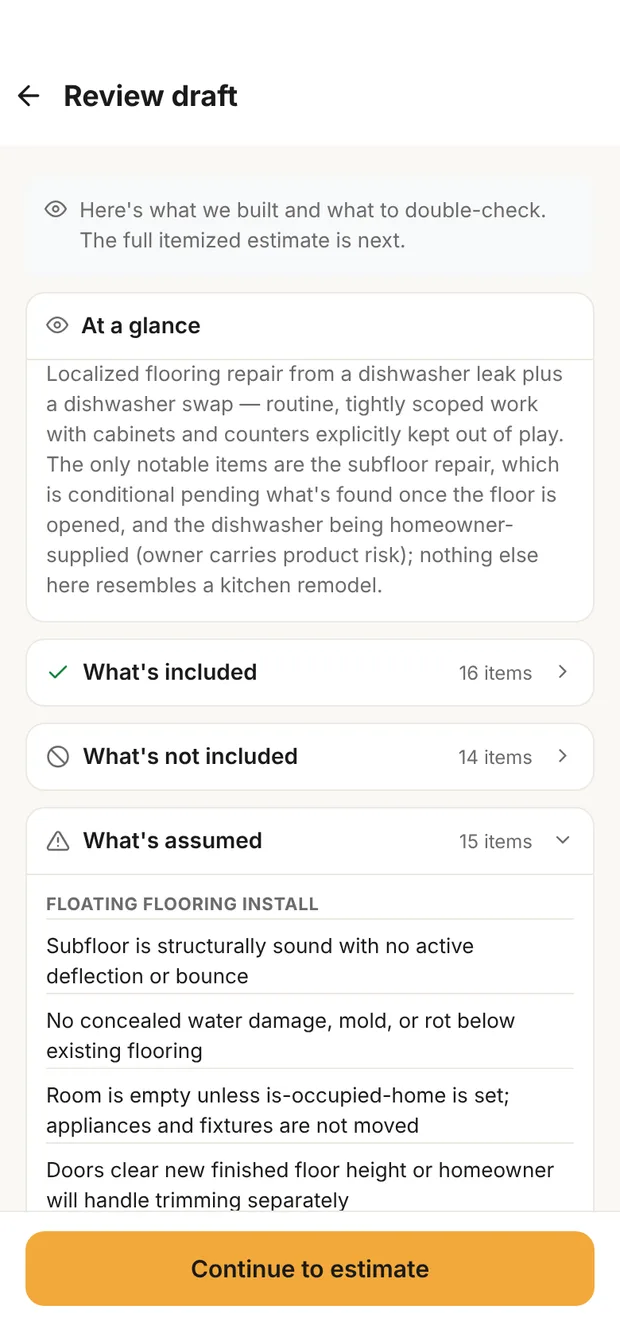
See what was assumed
Sample data from a different job. Clamp reads the description you type or dictate, then shows what it assumed before the itemized estimate.
The $4,691 is labor only: cable and pipe pulled through open framing instead of fished. It leaves out the drywall patching and painting a rewire or repipe in finished walls needs afterward, which the open-wall job does not. That is the case to put in front of an owner who is already gutting a house from these years: the wiring and pipe will never cost less to replace than they do now.
The pipe material matters too. If the same house had copper, the repipe in open walls prices at $6,522, because the catalog allows more labor to take out old threaded steel.
Code may let old wiring and pipe stay. The owner's insurer may not. There is no industry-wide rule, so ask the owner to check with their carrier before you price leaving a system in place.
One insurer's written rules
Aluminum wiringFlorida's Citizens asks for connections repaired by COPALUM or AlumiConn, documented by a licensed electrician.
PolybutyleneThe same insurer will not write new policies on homes over 20 years old with polybutylene piping.
DrainsIt also limits water losses that are not from weather to $10,000 unless the owner uses its repair program.
Old sewer lines are usually the owner's cost
Base policyA Texas state consumer office says a worn-out buried line is usually not covered by a base homeowners policy.
EndorsementService line coverage is a separate add-on that covers wear, rust and roots. Ask the owner whether they have it before a failed line becomes your change order.
Where the tables mislead
Conduit citiesChicago's code limits plastic cable to a short list of uses. Expect conduit, at any age.
PolybutyleneAn insurer bulletin from 2000 places it mostly in the Sun Belt, then the Mid-Atlantic and Pacific Northwest.
ABS or PVCPlumbers in some regions prefer ABS and in others PVC.
OrangeburgCity histories differ: one took it off its approved list in 1970, another saw it allowed until 1982.
PEXCalifornia allowed it statewide in 2009, pulled it in 2010 under a court order and restored it that August, years after the model codes.
Knob and tubeWashington lets loose or rolled insulation go over it once a licensed electrical contractor certifies the wiring. The national code does not, and a few states have their own exceptions.
What it means
Say the year built
Clamp reads the year from your description. For a house built before 1978 it prices lead-safe work, and for one built in 1980 or earlier it adds an asbestos test, each on its own line with a note. A rewire or repipe in a gutted house is priced in open walls. Everything it assumed is listed for you to change before the estimate goes out.
Before you price an old house, write down three things: the year built, what you saw in an open box, at the water heater and at the main stack, and what the owner's insurer says about it.
Questions
When was knob and tube wiring used?
Knob and tube was the common way to wire a house from about 1880 into the 1940s. There is no single end year: cloth-covered cable and armored cable took over through the 1930s and 1940s, so a house from those years can have any of the three. It has no ground wire, and the electrical code does not allow it in a wall or ceiling cavity filled with loose, rolled or foamed insulation.
When was aluminum wiring used in homes?
The Consumer Product Safety Commission's screening window is homes built, or rooms added or rewired, between 1965 and the mid 1970s. The concern is aluminum wire on 15 and 20 amp branch circuits, not the larger-gauge aluminum used for service entrance cables, clothes dryers and ranges. The commission accepts three permanent repairs: a copper rewire, COPALUM crimp connectors, or AlumiConn connectors at every connection.
When did houses get grounded outlets?
The National Electrical Code required a grounding-type receptacle at the laundry in 1947, at more locations such as garages and outdoors in 1956, and on general 15 and 20 amp receptacles from the 1962 edition. Each town adopted that edition on its own date, so a house from the early 1960s can go either way. A three-slot outlet does not prove a ground: test it.
When was polybutylene pipe used?
From about 1978 to 1995; one insurer bulletin puts the start at 1979. The supplier stopped selling pipe-grade resin in 1995 or 1996, and two national class settlements were approved on November 17, 1995. It is a gray flexible pipe usually marked PB2110, and copper stub-outs at the fixtures can hide it, so look near the water heater and along exposed runs in the basement or crawl space.
When did they stop using cast iron pipes in houses?
They did not. Cast iron was the standard drain and stack pipe from the 1850s into the 1950s, and plastic took over in new houses during the 1970s. Cast iron shipments peaked in 1972, and current plumbing codes still cover cast iron joints. A house from the 1960s or 1970s can have either, so look at the stack in the basement or crawl space instead of trusting a cutoff year.
When was Orangeburg pipe used?
No national range is documented. Orangeburg is a tar-impregnated fiber pipe used for the sewer line from the house to the street. One city records it from the early 1950s to the early 1970s and took it off its approved list in May 1970; another records it as common in the 1960s and 1970s, with the Uniform Plumbing Code allowing it from 1955 to 1982. It flattens under the weight of the soil, so run a camera before any cleaning tool goes in.
When did they stop using galvanized pipe?
There is no national stop year. The supportable statement is that it was commonly used in homes before the 1960s and that copper took over after World War II, so houses from the late 1940s and 1950s can have either. Pages that give a hard cutoff of 1950, 1960 or later are stating a rule of thumb, not a documented date.
Sources & provenance
- Repairing Aluminum Wiring, Publication 516 U.S. Consumer Product Safety Commission (official source)
- Building Regulations and Existing Buildings: Evolution of Building Regulations in the United States U.S. Department of Housing and Urban Development (official source)
- Old Wiring Methods American Society of Home Inspectors, ASHI Reporter (research)
- Knob-and-Tube Wiring International Association of Certified Home Inspectors (research)
- The History of GFCI Protection in the NEC IAEI Magazine (research)
- AFCIs and GFCIs National Association of Home Builders (research)
- Illustrated Code Catastrophes: Secs. 300.15, 410.23, 394.10, 394.12(5) EC&M (research)
- WAC 296-46B-394: Concealed knob-and-tube wiring Washington State Legislature (official source)
- NFPA 70 code-development record, Code-Making Panel 18, public input responses National Fire Protection Association (official source)
- Galvanized iron pipes East Bay Municipal Utility District (official source)
- Utility considerations in developing a galvanized iron water pipe management plan AWWA Water Science (research)
- A White Paper Review: History of Use and Performance of Copper Tube for Potable Water Service WSSC Water (official source)
- Design Guide: Residential PEX Water Supply Plumbing Systems NAHB Research Center for HUD's PATH program (official source)
- Plastic Pressure Pipe Materials in US/Canada: Presentation to ICC 815 Committee Plastics Pipe Institute (research)
- Hospitality Management Associates, Inc. v. Shell Oil Company, Opinion 25764 Supreme Court of South Carolina (official source)
- Polybutylene for Inspectors International Association of Certified Home Inspectors (research)
- History of Crosslinked Polyethylene (PEX) Tubing in North America, TR-56 Plastics Pipe Institute (research)
- CPVC Pipe and Tubing Plastics Pipe Institute (research)
- Big Changes Underway in Whole-House Re-Piping Market Home Innovation Research Labs (research)
- 42 U.S.C. 300g-6: Prohibition on use of lead pipes, solder, and flux U.S. House, Office of the Law Revision Counsel (official source)
- Guidance for Developing and Maintaining a Service Line Inventory U.S. Environmental Protection Agency (official source)
- 2021 Michigan Plumbing Code, Chapter 1: Scope and Administration International Code Council (official source)
- Clarification of February 1, 2022 Eligibility Rules Citizens Property Insurance Corporation (research)
- Municipal Code of Chicago 14E-3-334: Nonmetallic-sheathed cable City of Chicago (official source)
- California PEX Exclusion Removed PM Magazine (research)
- Residential: Using Type NM Cable in the Attic Electrical Contractor Magazine (research)
- What Is Up or Down in New US Homes Home Innovation Research Labs (research)
- What is Polybutylene Piping, Loss Control Technical Bulletin 1800 Philadelphia Insurance Companies (research)
- Plumbing Pipes American Society of Home Inspectors, ASHI Reporter (research)
- Cast Iron Soil Pipe and Fittings Handbook Cast Iron Soil Pipe Institute (research)
- The Rehab Guide, Volume 8: HVAC/Plumbing U.S. Department of Housing and Urban Development (official source)
- Thermoplastic Piping in Residential Plumbing Systems, NBS Building Science Series 111 National Bureau of Standards (official source)
- Home Inspection and Plastic Plumbing Systems American Society of Home Inspectors, ASHI Reporter (research)
- The Facts About Orangeburg Pipe City of Tempe (official source)
- Orangeburg Sewer Piping City of Ann Arbor (official source)
- Residential Rehabilitation Inspection Guide U.S. Department of Housing and Urban Development (official source)
- InterNACHI's Standard Estimated Life Expectancy Chart for Homes International Association of Certified Home Inspectors (research)
- Significant Changes to the 2018 IPC: Reuse of Buried Drain and Sewer Piping (Section 703.4) International Code Council (official source)
- CodeNotes: Rehabilitation of Building Sewers and Building Drains in the I-Codes International Code Council, Building Safety Journal (official source)
- CodeNotes: Replacement of Underground Building Sewers and Building Drains in the I-Codes International Code Council, Building Safety Journal (official source)
- CodeNotes: Relining Building Sewers and Building Drains in the I-Codes International Code Council, Building Safety Journal (official source)
- New York City Plumbing Code 2022, Chapter 7: Sanitary Drainage City of New York (official source)
- Citizens Board approves policy language changes Citizens Property Insurance Corporation (research)
- Know Your Coverage: Service Line Coverage Texas Office of Public Insurance Counsel (official source)
- Updated Policy Language and New Coverage Limits for Nonweather Water-Related Losses Citizens Property Insurance Corporation (research)
- Asbestos Cement (AC) Pipe Replacement U.S. Environmental Protection Agency (official source)
- Clamp catalog: whole-house rewire and water supply repipe, priced 2026-11-13 Clamp (research)